Why a converted dry blasting cabinet deserves a closer look
Adding a pump and water system to a dry blasting cabinet can create a lower-cost route into wet blasting. But a working pump does not tell you whether the cabinet is suitable for prolonged contact with water and abrasive slurry.
Some conversions use powder-coated mild steel. In that construction, the coating provides a barrier between the water and steel underneath. Abrasive wear, chips, scratches and exposed edges can break that barrier. Once water reaches unprotected mild steel, it can corrode.
That matters because the cabinet and sump are part of the same circulating system used to clean your components. Corrosion debris and coating fragments can enter the slurry, affecting cleanliness and consistency and adding maintenance work.
Our advice: avoid a cabinet that depends solely on an internal paint or powder-coat finish to protect mild steel from the wet blasting process. Ask how the manufacturer protects the chamber, sump, seams and fixings as the machine wears.
Can contaminated slurry leave rust marks on aluminium?
Aluminium does not produce the red-brown rust associated with iron. However, iron or steel particles introduced during abrasive processing can become embedded in its surface. Those particles can subsequently rust and stain the component.
A corroding mild-steel cabinet is therefore an avoidable potential source of ferrous contamination in a recirculating wet blasting system. The result may be a freshly cleaned aluminium part that later develops unwanted brown staining.
Cabinet material is only part of the answer. Rusty workpieces and contaminated media can introduce debris too. Keep slurry clean, follow the manufacturer's maintenance guidance, and rinse and dry components appropriately after blasting.
Why we choose stainless steel
Stainless steel offers corrosion resistance through the material itself, rather than relying solely on a painted barrier over mild steel. For a machine repeatedly exposed to water and abrasive media, that is a valuable starting point.
It reduces the risk of the cabinet becoming a source of ordinary steel corrosion debris, and avoids relying on an internal powder-coat layer to protect a mild-steel shell.
Stainless steel still needs sensible maintenance and suitable water and cleaning chemistry. Purpose-built polymer and composite cabinets can also be suitable for wet blasting. The principle is to choose construction designed for a wet, abrasive environment—not simply a dry cabinet with water added.
Choose the machine around your parts
Measure your largest regular component, then allow room to turn it and reach all surfaces with the blast gun. Check the door opening and usable internal space, as well as the overall cabinet dimensions.
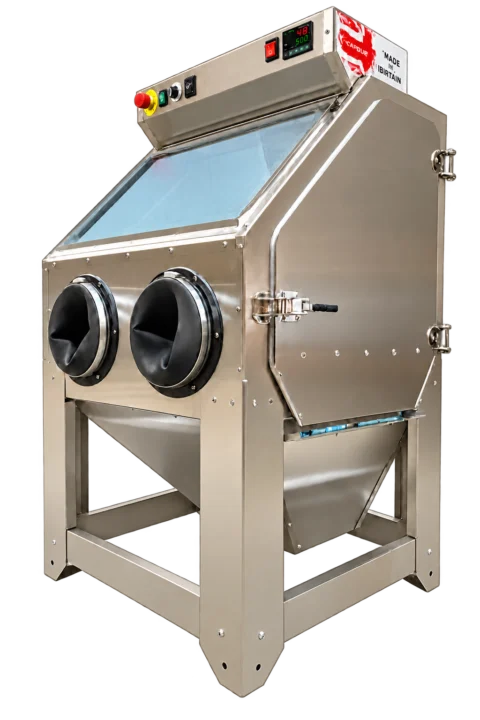
Viper
A stainless steel self-assembly machine for owners who are happy to build their cabinet. Allow approximately six hours; manuals are supplied and an air riveter is recommended.
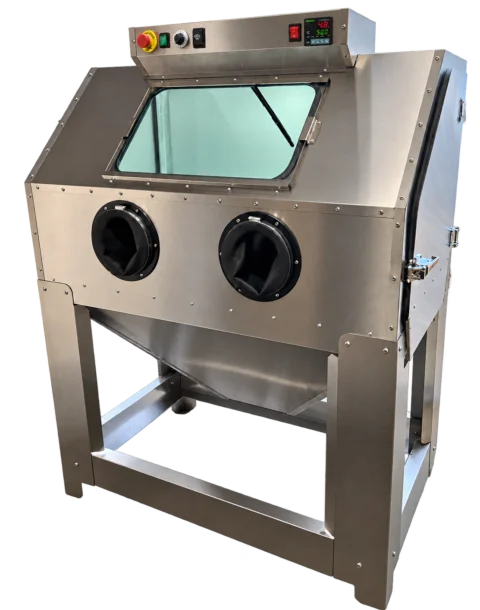
VapourMAX 650
A fully assembled option for professional workshops, particularly those working with motorcycle parts.
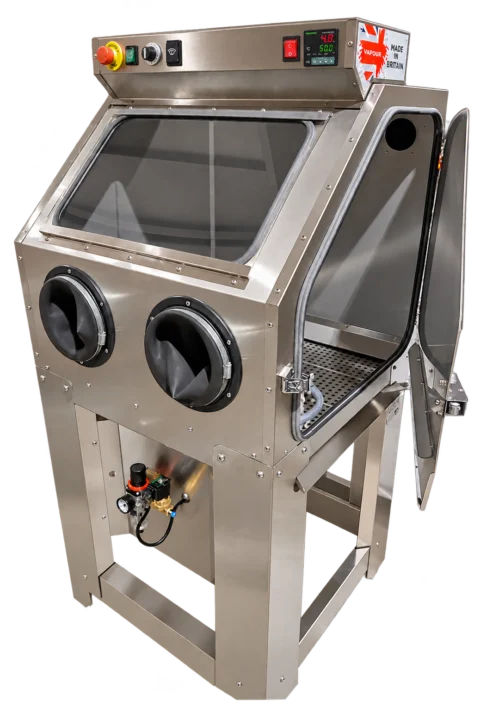
These are starting points: always confirm the dimensions and suitability for your actual components before ordering.
Seven things to check before ordering
- Cabinet and sump material. Ask about the wetted construction, not just the external appearance or stand.
- Compressor requirements. Match the machine's required air delivery and working pressure to your compressor's delivered output. Receiver size alone does not tell you whether it can keep up.
- Usable space and access. Make sure the part fits through the opening and can be handled comfortably inside.
- Visibility. Compare lighting, window cleaning and rinse arrangements so you can see the finish as you work.
- Media and maintenance. Check which media suits your application, how the slurry is maintained and how easily the sump can be drained and cleaned.
- Support and spare parts. Find out who you can speak to, what parts are available and what the warranty covers.
- The complete cost. Compare the machine, required options, compressor needs, VAT and delivery—not just the headline price.
Not sure which machine fits your workshop?
Send Max a photo. Get advice before you buy.
Show us the parts you want to clean, tell us their approximate dimensions and let us know which compressor you have. We will help you choose a suitable machine and explain what you need to get started.